
Nehemiah
The Book of Nehemiah is concerned with the last return; the rebuilding of the walls of Jerusalem and the repopulation of the city. Similar to the previous missions, this task is met with opposition from the surrounding peoples; the opposition is overcome, and the project ends with a joyful celebration. Following a brief interlude, Nehemiah returns for a second term as governor and carries out a number of reforms. -Mark Throntveit on Enter the Bible
Monday, March 16
Chapter 11
Chapter 11 is not part of the Nehemiah Memoir. It’s in third person and Nehemiah is not mentioned. We get the names of folks who return to help repopulate Jerusalem. There is a similar list of people who returned to the land after the exile in 1 Chronicles chapter 9, but the two lists differ greatly.
It seems like Jerusalem has attracted a lot of leaders, but not enough ordinary people, so they do a sort of “people tithe” and cast lots, sending a tenth of ordinary people to live in the city. Klein writes, “the people destined for the move willingly consented to it and so set an example for anyone who would move to Jerusalem in the future.”
The city is now considered holy since the Temple has been rebuilt, the wall is restored, and the law was publicly read and agreed to.
We get the names of folks from the tribes of Judah and Benjamin who returned plus leaders and clergy (priests, Levites, gatekeepers). Klein explains why we are given their genealogies- “the long genealogies give legitimation to the individuals in these verses. In a holy city, purity of laypeople is as important as purity of priests.” Purity, as in, connection to the tribe they claim.
In verses 25-35 we get a list of towns. The towns described here make up a much larger geographical area than the actual area where the people lived after the exile. Maybe the author exaggerated because that’s what they wished it was like, or because it would make them look better? Why do you think the author exaggerated about all the towns where the people live?
It seems like Jerusalem has attracted a lot of leaders, but not enough ordinary people, so they do a sort of “people tithe” and cast lots, sending a tenth of ordinary people to live in the city. Klein writes, “the people destined for the move willingly consented to it and so set an example for anyone who would move to Jerusalem in the future.”
The city is now considered holy since the Temple has been rebuilt, the wall is restored, and the law was publicly read and agreed to.
We get the names of folks from the tribes of Judah and Benjamin who returned plus leaders and clergy (priests, Levites, gatekeepers). Klein explains why we are given their genealogies- “the long genealogies give legitimation to the individuals in these verses. In a holy city, purity of laypeople is as important as purity of priests.” Purity, as in, connection to the tribe they claim.
In verses 25-35 we get a list of towns. The towns described here make up a much larger geographical area than the actual area where the people lived after the exile. Maybe the author exaggerated because that’s what they wished it was like, or because it would make them look better? Why do you think the author exaggerated about all the towns where the people live?
Tuesday, March 17
Chapter 12:1-26
More names today! Lots and lots of names. This section is a list of priests and Levites.
Klein writes, “verses 12-21 consist of a master list of twenty-two priestly houses, followed in each case by the name of the head of that house in the time of the high priest Joiakim.”
Jeshua and Joiakim were the first two high priests after the return from exile.
The author thought it was very important for us to know about the priests and Levites in Jerusalem after the exile- continuing Temple worship as they had before the exile.
Who are Levites again? Levites are descended from Jacob’s son Levi, they are from the Tribe of Levi. They are set apart to serve God. Remember how in Genesis Jacob wrestled with God and was renamed Israel? The descendants of Jacob are organized into tribes based on which of the sons you descend from. When the Levites (descendants of Levi) were set apart, only 11 tribes were left, so they divided Joseph’s tribe in two – one tribe for each of Joseph’s two sons (Manasseh and Ephraim). Fascinating, right?! The Levites play an important role in the wilderness after the exodus – they were in charge of packing up, carrying, and then setting back up the tabernacle and everything the tabernacle contained. Aaron and Moses were descended from Levi. Aaron is the first priest. Priests must be descended, not only from Levi, but from Aaron as well.
Klein writes, “verses 12-21 consist of a master list of twenty-two priestly houses, followed in each case by the name of the head of that house in the time of the high priest Joiakim.”
Jeshua and Joiakim were the first two high priests after the return from exile.
The author thought it was very important for us to know about the priests and Levites in Jerusalem after the exile- continuing Temple worship as they had before the exile.
Who are Levites again? Levites are descended from Jacob’s son Levi, they are from the Tribe of Levi. They are set apart to serve God. Remember how in Genesis Jacob wrestled with God and was renamed Israel? The descendants of Jacob are organized into tribes based on which of the sons you descend from. When the Levites (descendants of Levi) were set apart, only 11 tribes were left, so they divided Joseph’s tribe in two – one tribe for each of Joseph’s two sons (Manasseh and Ephraim). Fascinating, right?! The Levites play an important role in the wilderness after the exodus – they were in charge of packing up, carrying, and then setting back up the tabernacle and everything the tabernacle contained. Aaron and Moses were descended from Levi. Aaron is the first priest. Priests must be descended, not only from Levi, but from Aaron as well.
Wednesday, March 18
Chapter 12:27-43
Now that ordinary people have moved into Jerusalem, the holy city, and we know all about the priests and Levites, it’s time to dedicate the wall.
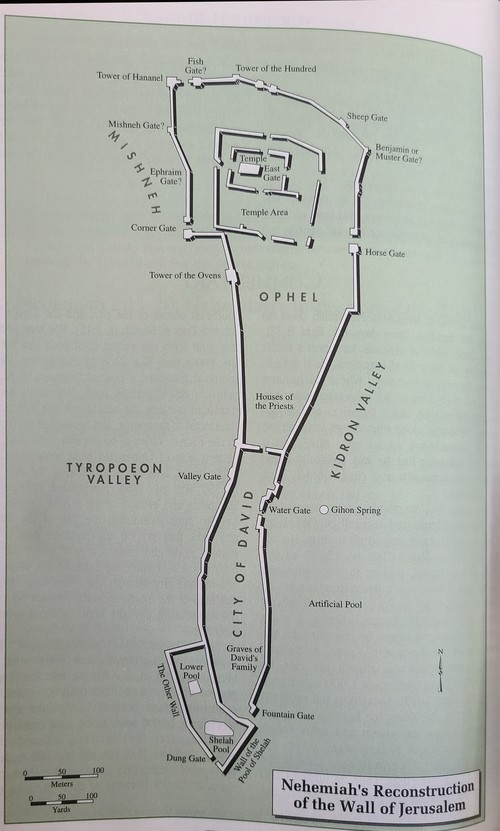
You’d think that this part of Nehemiah would have more descriptions of how they dedicated the wall and their celebrations, but most of it is taken up with names. We get the names of gates and towers. This diagram is helpful when imagining the movements of this part of chapter 12.
The priests and Levites purify themselves and the people and the gates and the wall. Klein writes, “Purification before a cultic act might include sexual abstinence, washing one’s clothes [both of these were required of the people in Exodus 19, before the giving of the Ten Commandments], shaving the entire body, offering sacrificial animals, and sprinkling one’s body or an object with ritually prepared water.”
There is a lot of “giving thanks” and then we learn in verse 43, “They offered great sacrifices that day and rejoiced, for God had made them rejoice with great joy; the women and children also rejoiced. The joy of Jerusalem was heard far away.” No one was left out of the rejoicing!
Why do you think God wanted them to rejoice? Why not just move in and get on with regular ordinary life? Do you take time to rejoice? Do we as a church community? Do you value joy and celebration?
You’d think that this part of Nehemiah would have more descriptions of how they dedicated the wall and their celebrations, but most of it is taken up with names. We get the names of gates and towers. This diagram is helpful when imagining the movements of this part of chapter 12.
The priests and Levites purify themselves and the people and the gates and the wall. Klein writes, “Purification before a cultic act might include sexual abstinence, washing one’s clothes [both of these were required of the people in Exodus 19, before the giving of the Ten Commandments], shaving the entire body, offering sacrificial animals, and sprinkling one’s body or an object with ritually prepared water.”
There is a lot of “giving thanks” and then we learn in verse 43, “They offered great sacrifices that day and rejoiced, for God had made them rejoice with great joy; the women and children also rejoiced. The joy of Jerusalem was heard far away.” No one was left out of the rejoicing!
Why do you think God wanted them to rejoice? Why not just move in and get on with regular ordinary life? Do you take time to rejoice? Do we as a church community? Do you value joy and celebration?
Thursday, March 19
Chapter 12:44-13:3
In today’s section we learn that they’re reestablishing various systems that were not functioning during the exile. They appoint officials to be in charge of the donations to the Temple and to the clergy.
You can learn more about the banning of Ammonites and Moabites to the tenth generation from participating in the worship of Israel in Numbers 22-24.
The people read the law of Moses, probably Deuteronomy 23:3-6 and decide to take action. Remember! When we read about exclusion or prohibitions in the Bible our first questions is, “Why? What were they worried about?”
Up to this point in Nehemiah they’ve repaired the wall, the Temple is functioning, they have priests and Levites and leaders living in the city, ordinary people move there to live and work, they dedicated the wall with great joy – it’s all ready, everything is complete. What do you think they’re worried about? Maybe they worry that if they allow foreign folks to participate in worship, they will have to endure another exile? What do you think?
Klein writes, “The people heard the law and did it (13:3). In Jewish tradition, the festival called Simhat Torah (Joy in the Law) is a celebration at the end of the annual reading of the entire Pentateuch. The community rejoices because once more it has experienced the fullness of the Torah. Joy in the Torah can also be expressed by the willingness to follow its teaching and advice, even in such mundane matters as ecclesiastical contributions and separating oneself form anyone whose character is flawed by inhospitality.”
You can learn more about the banning of Ammonites and Moabites to the tenth generation from participating in the worship of Israel in Numbers 22-24.
The people read the law of Moses, probably Deuteronomy 23:3-6 and decide to take action. Remember! When we read about exclusion or prohibitions in the Bible our first questions is, “Why? What were they worried about?”
Up to this point in Nehemiah they’ve repaired the wall, the Temple is functioning, they have priests and Levites and leaders living in the city, ordinary people move there to live and work, they dedicated the wall with great joy – it’s all ready, everything is complete. What do you think they’re worried about? Maybe they worry that if they allow foreign folks to participate in worship, they will have to endure another exile? What do you think?
Klein writes, “The people heard the law and did it (13:3). In Jewish tradition, the festival called Simhat Torah (Joy in the Law) is a celebration at the end of the annual reading of the entire Pentateuch. The community rejoices because once more it has experienced the fullness of the Torah. Joy in the Torah can also be expressed by the willingness to follow its teaching and advice, even in such mundane matters as ecclesiastical contributions and separating oneself form anyone whose character is flawed by inhospitality.”
Friday, March 20
Chapter 13:4-31
In this chapter Nehemiah tells us all the corrective action he took in making sure that things were done properly, in accordance with the law:
Tobiah was living in the Temple, in a room especially for grain offering, frankincense, vessels, and the tithes of grain, wine, and oil. Nehemiah threw out all of Tobiah’s furniture and put the room back to its intended use.
The Levites and singers were not getting food from the offering, so they had to go back to farming. Nehemiah corrected that, making sure they could do their duty and not have to worry about creating food for themselves.
Nehemiah stopped people working and buying things on the sabbath. He was adamant that they keep the sabbath day holy. Why do you think God established the sabbath? Why do you think Nehemiah made keeping the sabbath holy a priority? What good comes from setting time aside to rest and worship? When the people were in exile observing the sabbath was one of just a few ways the people were able to maintain their identity. Perhaps that’s why Nehemiah is so concerned that they continue to observe the sabbath properly.
Do you have any rhythms of your week or day that helps you maintain your identity as a Christian? That connects you to the church community? What are they?
Nehemiah wants to keep the community complete and dedicated to the same thing- pulling together in the same direction. He is worried that marrying foreigners will inhibit this goal. He has the people take an oath saying they won’t let their children marry foreigners.
Nehemiah asks God to remember him and his deeds three times in this section. What do you make of this prayer? Do you ask God to remember you?
Tobiah was living in the Temple, in a room especially for grain offering, frankincense, vessels, and the tithes of grain, wine, and oil. Nehemiah threw out all of Tobiah’s furniture and put the room back to its intended use.
The Levites and singers were not getting food from the offering, so they had to go back to farming. Nehemiah corrected that, making sure they could do their duty and not have to worry about creating food for themselves.
Nehemiah stopped people working and buying things on the sabbath. He was adamant that they keep the sabbath day holy. Why do you think God established the sabbath? Why do you think Nehemiah made keeping the sabbath holy a priority? What good comes from setting time aside to rest and worship? When the people were in exile observing the sabbath was one of just a few ways the people were able to maintain their identity. Perhaps that’s why Nehemiah is so concerned that they continue to observe the sabbath properly.
Do you have any rhythms of your week or day that helps you maintain your identity as a Christian? That connects you to the church community? What are they?
Nehemiah wants to keep the community complete and dedicated to the same thing- pulling together in the same direction. He is worried that marrying foreigners will inhibit this goal. He has the people take an oath saying they won’t let their children marry foreigners.
Nehemiah asks God to remember him and his deeds three times in this section. What do you make of this prayer? Do you ask God to remember you?